The Ministry of Health, Welfare, and Sport is working on standards and a nationwide network for data exchange. But Bianca Rouwenhorst is calling on healthcare providers and suppliers not to wait. “Take up the challenge and get started right away.”
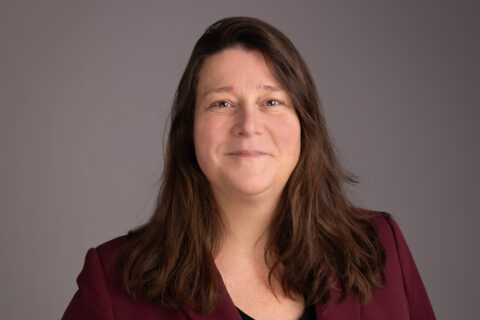
What is the Ministry of Health, Welfare and Sport's digital strategy for the coming years? A question that concerns a lot of people, given the great interest in the keynote by Bianca Rouwenhorst, director of information policy and CIO of VWS. All the chairs were taken, people were sitting on the floor at the sides and even outside the fences interested parties were lined up to listen.
Trust as the most important pillar
“Trust is one of the most important pillars of digital transformation, data exchange, and data availability. If we don’t address that trust, then we can all want to create a digital transformation, but we’ll be doing it for nothing.” The concept of trust is therefore central to the National Vision on Data Availability: healthcare providers must be able to trust that data is up-to-date and accurate, and citizens must be able to trust that their data is handled properly and securely.
Reliable infrastructure
But to get there, the first thing we need is a reliable infrastructure through which data can flow smoothly and securely. “The sector itself shouldn’t be the one to build that nationwide ‘road network.’ That should be a public responsibility.” That’s why the Ministry of Health, Welfare, and Sport (VWS) is working with a national coalition to establish such a nationwide network.
Such a network must, at a minimum, have a number of generic functions: identification & authentication, authorization, consent, localization, and addressing. “These five generic functions will be technically ready and ready for implementation in 2025—this year,” Rouwenhorst announced.
Opt-out system
About that permission to share data: with the advent of the EHDS, the Netherlands is opting for an opt-out system in (mandatory) imitation of European rules. "The consent function will become opt-out in a couple of years, we just wrote in a letter to the Lower House. So if you object, you have to start registering that."
Rules and Agreements
In addition to the generic functions, a well-functioning infrastructure also requires rules and agreements, Rouwenhorst explains. “We’ve decided to use a single set of agreements for this. That’s Twiin.” The first healthcare institutions are already adopting that standard, according to Rouwenhorst.
But even with a national infrastructure and a Twiin standard, you're not there yet, continues Rouwenhorst. "Different systems speak in different languages. But for data to flow securely, you need unity of language and unity of technology."
Make it a legal standard
SNOMED and LOINC are those kinds of standards. "I can tell you here that we are looking into the extent to which we need to make that a legal requirement. Then we are going to mandate the use of these standards in this way. But I urge you: don't wait until that legislation is done. See what you can already do with it now in your own information systems."
More control
The purpose of a reliable and secure data-sharing system is to give citizens more control over their own data, says Rouwenhorst. “Just imagine how we could improve patient safety by involving citizens in keeping the data up to date.”
Of course, this must be done safely. The NEN7510 standard is mandatory, “but it’s alarming how few healthcare institutions are actually able to meet that requirement.”
PGOs from private market players
This will happen in various ways. Similar to the individual pension statement, there will be a “my health overview,” where everyone can view their own data. It will be free of charge, the same for everyone, and provided as a public government service. In addition, there are PGOs—personal health environments—offered by private market players, either free of charge or for a fee, allowing users to choose what suits them best. “It’s really up to the market to develop that.”
“Get started.”
With a clear call to action to all those healthcare professionals, suppliers and companies that had flocked, Rouwenhorst concluded her keynote. "Don't wait until we have that nationwide network. You can do things yourself right now. Pick up that gauntlet: delve into the WEGIS and the EHDS. Get to work on unifying language and technology. Work on data quality. Get off that stand and get in the ring!"