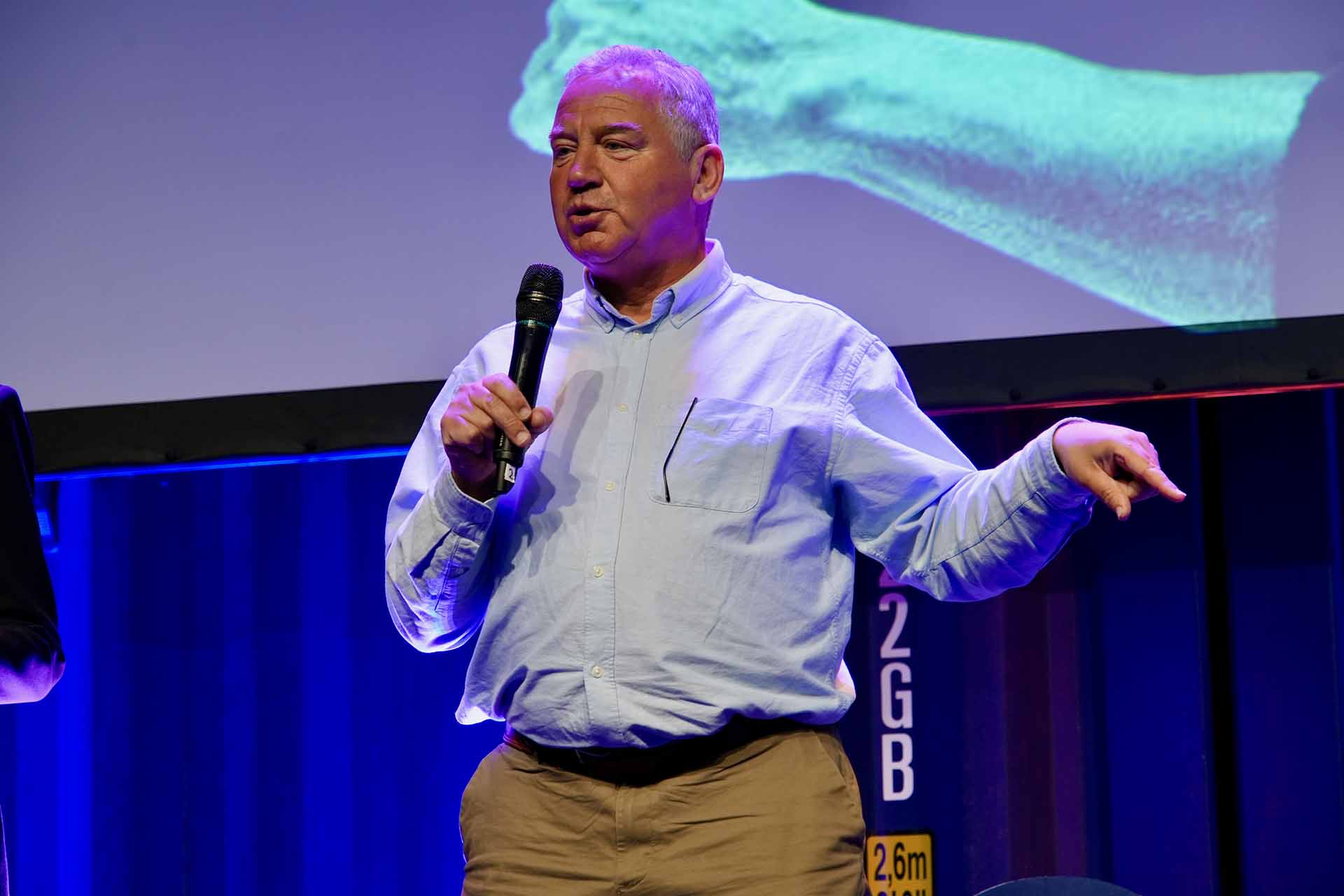
We need to stop whining about the healthcare crisis and healthcare breakdowns, says Marcel Levi, because the healthcare system is very successful. Of course, there are problems. One of the solutions is to reorganize healthcare: networks instead of market forces.
Medicine has achieved incredible successes in recent years, Marcel Levi, chairman of NWO, told Care & ict on Thursday. "Because of impulses from cell biology, genetics, data science, physics, so on and so forth, you can't think of a disease that is not very much better in 2025 than it was five, 10 or 15 years ago."
Laws and regulations
Thereby, the healthcare system in the Netherlands is super-organized . "For that, we all have different laws, different regulations, different funding streams. Perhaps the biggest problem is that those streams and laws don't communicate very well with each other."
Chaos and hustle and bustle
Because the reality on the ground is often a bit more challenging, with the daily chaos, hustle and bustle, and capacity issues. “But a healthcare crisis? When I walk around the hospital, I don’t notice it.” Paraphrasing Mark Rutte, he even said: “It’s never been as cool as it is now!”
A consequence of our success
Of course, he does not deny the problems in healthcare, such as too few people, too little money and too little capacity, but they are mostly the result of our own success, Levi believes. The chances of dying of a heart attack have dropped dramatically. "You don't manage to die from that anymore. The cardiologists don't allow that."
Public Enemy
Life expectancy has risen sharply. “So don’t let it drive you crazy. It’s not asylum seekers or immigration that are Public Enemy Number One. It’s the centenarians who are going to overwhelm us.” The healthcare system needs to be adapted to this. That’s happening, but not fast enough, according to Levi.
All hospitals are the same
While the number of beds and the average length of stay have fallen dramatically over the past few decades—from 80,000 beds in 1970 to 12,500 in 2025—the number of hospitals has remained unchanged: there are still well over eighty.
And that’s the key to change, according to Levi: “Those hospitals are all the same. They all want as many specialties as possible, they all have an emergency room, and they all have a highly qualified ICU. We have enough PET-CT capacity in the Netherlands to cover half of Germany. Why don’t we organize this differently?”
Networking
According to Levi, the answer lies in concentration, decentralization, and the formation of regional networks. Doing certain procedures more often in some hospitals and less often in others. “We need to form regional networks: a large hospital where complex procedures are performed and smaller hospitals where simpler procedures are performed, but closer to home.”
“We have to do it ourselves.”
Levi acknowledges that this is a challenge both from an organizational and an IT perspective. Because who’s going to handle it? Not politicians, he says. “There’s only one answer to that question: we have to do it ourselves.”
Levi believes that the potential of all the good ideas from people in the healthcare sector has not been fully realized so far. That’s why he called on everyone to channel a little more Michael Jordan: “We’re very successful, and even though we may be reaching the limits of our success, above all, be proud and celebrate your success!”